

A seller in Spokane called me last spring convinced she owed the state seven percent of her profit. I hear that worry a lot. Confusion around the capital gains tax in Washington has cost people real money in delayed decisions.
Does Washington’s Capital Gains Tax Apply When You Sell Your House?
The real property exemption has nothing to do with how long you owned the place.
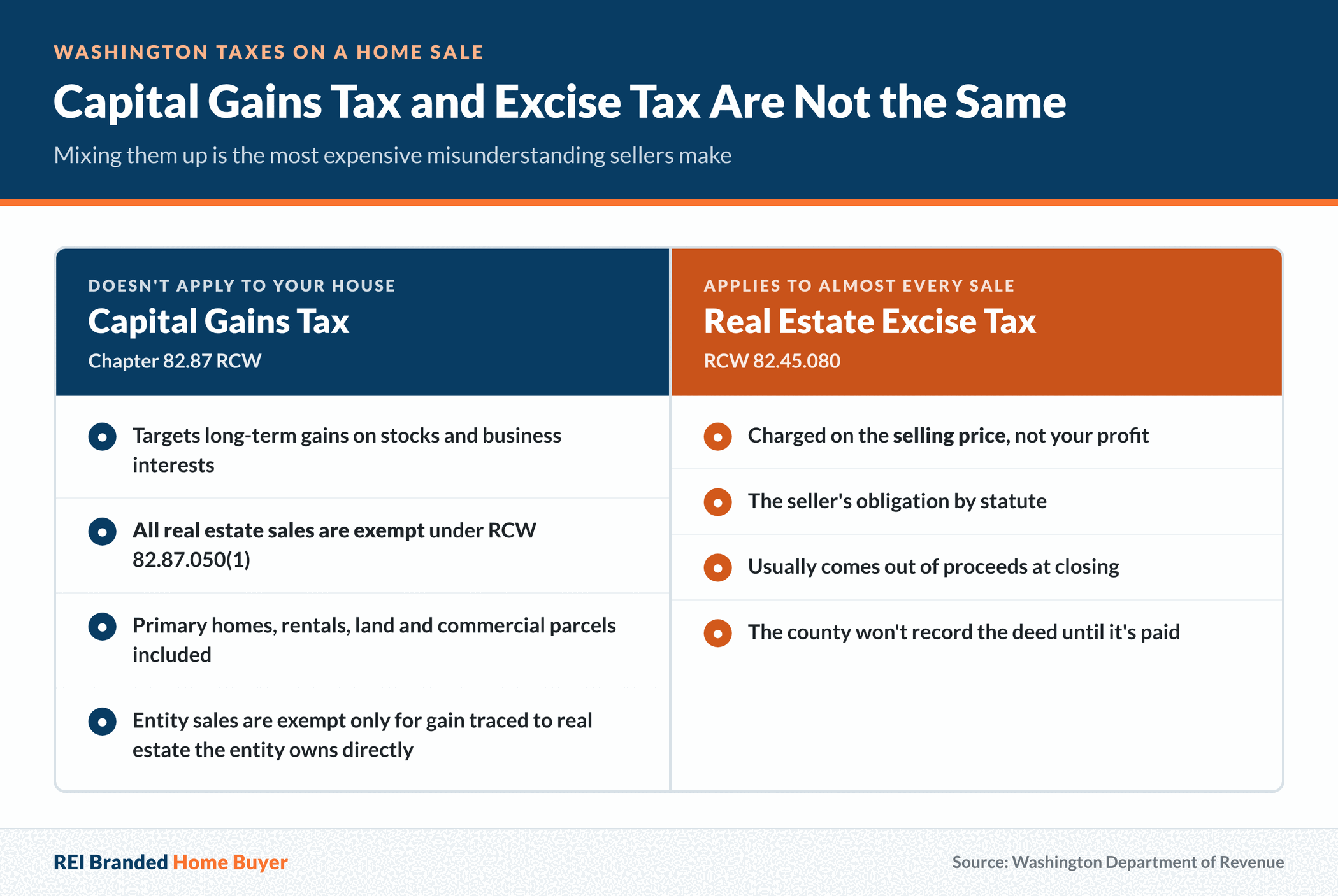
Washington’s capital gains tax is an excise tax on long-term gains from things like stocks and business interests. Real estate sits outside it. Under RCW 82.87.050(1), all sales of real estate are exempt from the tax. Whether you’re selling a primary home, a rental, or a commercial parcel, you owe nothing on that front. The Department of Revenue spells it out plainly on its capital gains tax page, listing real estate first among exempt assets.
A retired couple called me with that same fear. The husband’s split-level had a workshop in the garage packed with forty years of woodworking tools, and they were terrified a state tax bill would eat the money they needed for his care. We walked through the exemption at their kitchen table on a Saturday. I’ve seen that kind of relief on a lot of faces doing this work, which tells me how badly this topic gets explained around Washington.
What Does Washington’s Real Estate Exemption Say?
Sell the house itself, and you skip that state tax.
Selling an interest in a company that owns the house is a different move, and Washington law treats the two differently. Gains from selling interests in a privately held entity are exempt only to the extent the gain traces directly to real estate the entity owns directly. The allocable amount starts from the fair market value of that real estate minus its basis, times your ownership percentage in the entity.
Layered structures set a second trap. Real estate held through a lower-tier entity gets left out of the exemption math under RCW 82.87.050(2)(b)(iii). Investors who stack holding companies on holding companies, a common setup in Washington, can quietly strip away the protection they thought they had.
Direct transfers are the clean path. When the real estate itself changes hands by deed, real estate contract, judgment, or another lawful instrument recorded with the county, the transaction generally falls under the real estate exemption. You usually won’t need to dig any further.
Capital Gains Tax Versus Other Washington Taxes: What’s the Difference?
A Yakima landlord once told me he was thrilled to owe “no tax” on his duplex sale.
Then came the line for the real estate excise tax. Mixing that up with the gains levy in Washington is the single most expensive mistake I see. REET is charged on the selling price of real property, not on the seller’s profit. RCW 82.45.080 makes it the seller’s obligation, and it usually comes straight out of your proceeds at closing.
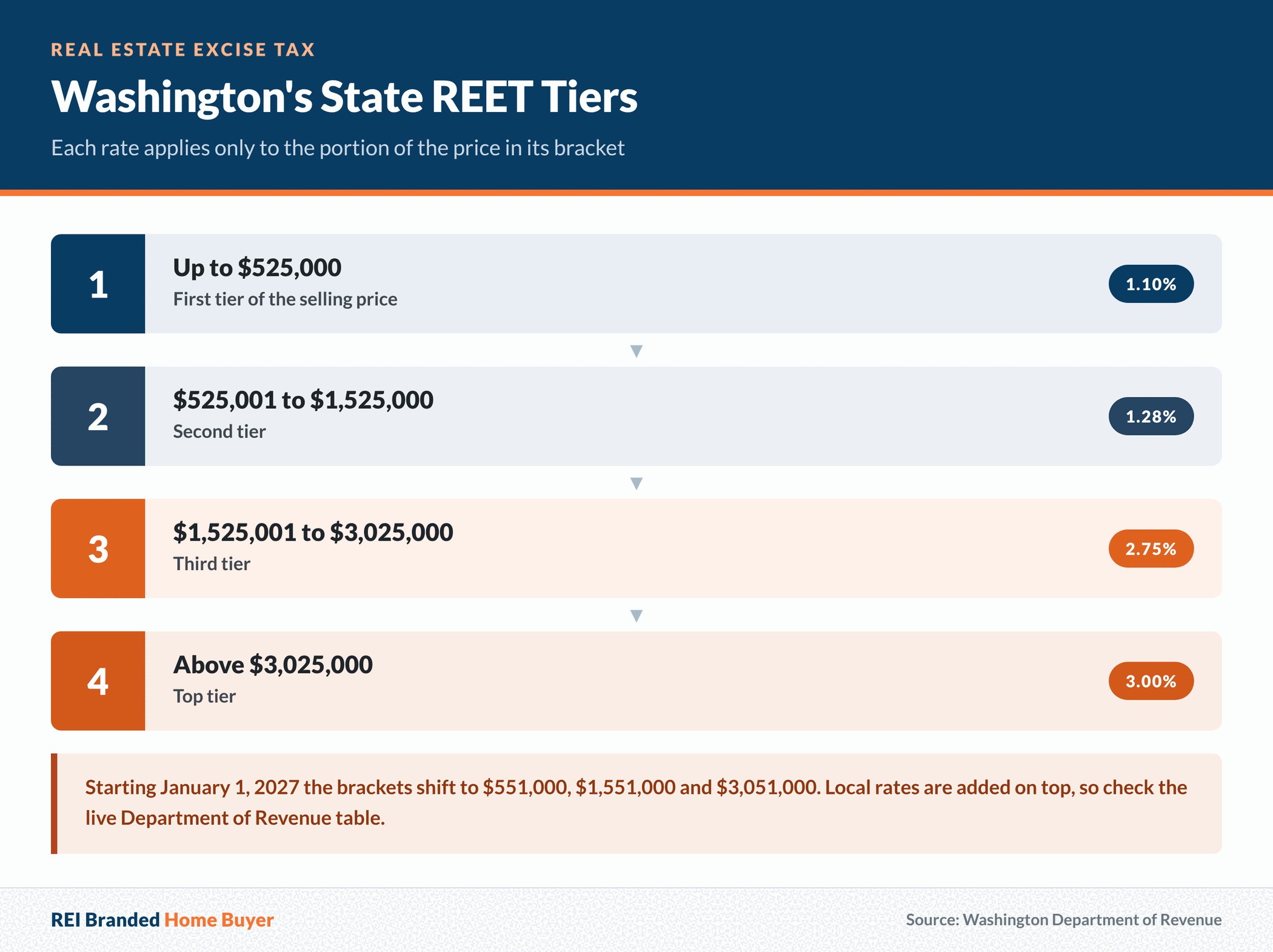
Washington uses tiers for the state portion. Rates run 1.1% on the portion up to $525,000, 1.28% from $525,001 to $1,525,000, 2.75% from $1,525,001 to $3,025,000, and 3.0% above $3,025,000. The Department of Revenue posts the current tables and local rates on its real estate excise tax page.
Beginning January 1, 2027, the brackets move to $551,000, $1,551,000 and $3,051,000. If you’re closing near a boundary in Washington, check the live table, not a blog chart.
Who Is Impacted by Washington’s Capital Gains Tax Rules?
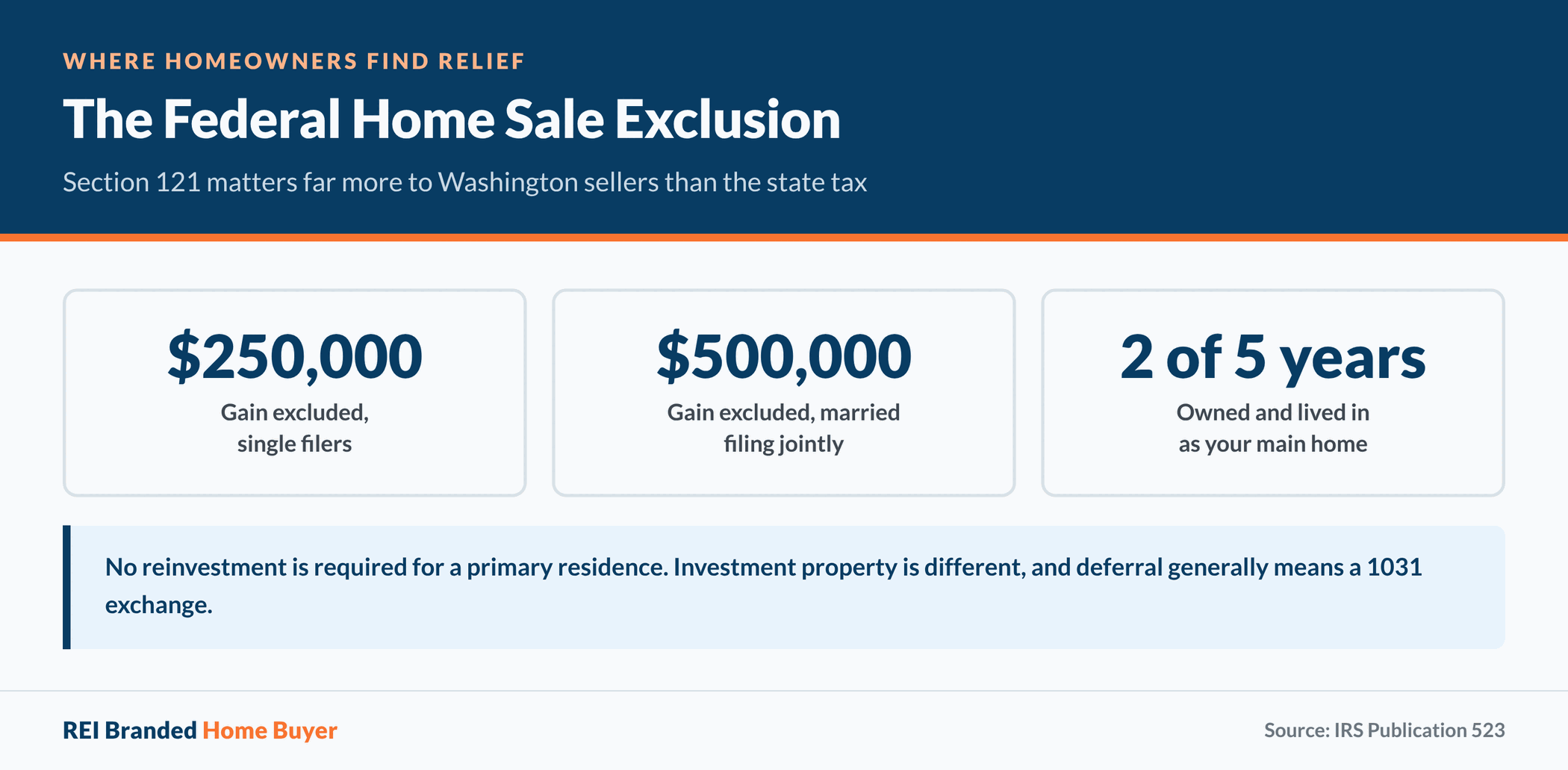
The federal side is where homeowners actually find relief. Section 121 lets you exclude up to $250,000 of gain from the sale of a main home, or up to $500,000 for married couples filing jointly. You must have owned the home for at least two years and used it as your main home for two of the five years before the sale date. The IRS covers the mechanics in Publication 523.
On the state side, net long-term gains above an annual standard deduction, set at $278,000 for 2025, face a 7.0% rate. Starting with tax year 2025, gains above $1 million are taxed at 9.9%.
In Washington, sellers should care more about the federal exclusion than the state question. In September 2026 the statewide median sale price was $590,204, down 1.5% year over year, and homes sat on the market a median of 33 days. Long-tenured owners in Ballard, Wallingford, or the Eastside can blow past that federal limit without owning a mansion.
How Do Fix-and-flips and Short Holding Periods Get Taxed in Washington?
“I only held it nine months. Does that change the state tax on it?”
Federal treatment is a different animal. Dealers who hold property as inventory recognize ordinary income, so it falls outside this tax framework. Buy, renovate, and resell on repeat, and the IRS may classify you as a dealer. That strips away preferential capital gains rates and adds self-employment tax questions.
Excise tax hits every flip too, at full freight on the gross price. Thin-margin flips in Washington die on that line more often than people admit.
My opinion? Flippers obsess over the purchase price and underbudget the exit costs. Run your excise math before you write the offer.
How Do These Rules Affect Common Washington Investment Strategies?
1031 exchanges still work in Washington, though they solve a federal problem, not a state capital gains tax problem. Deferring federal gain while rolling into a bigger asset makes sense for a lot of Washington investors. Excise tax follows the transfer either way, though, and deferring one cost doesn’t erase the other. Installment sales spread federal recognition across tax years without adding any state exemption you didn’t already have.
Portfolio sellers face a wrinkle most don’t price in. When several parcels sell in one transaction, the graduated REET rate applies to the combined value of all of them.
Market timing still matters. As of July 2026, the average Washington home value sat at $601,545, down 0.4% over the year, with homes going pending in roughly 19 days. Quick pending times help investors who need predictable exits. A direct sale through REI Branded Home Buyer takes the listing variable out entirely when a closing date has to be certain.
Should You Sell the Property Directly or Sell Your Entity Interest?
If your LLC holds one house and nothing else, selling the house is usually simpler than selling the LLC.
Direct deed transfers close faster and land squarely inside the Washington capital gains tax exemption, with no allocation exercise.
Multi-property portfolios, partnerships with messy basis histories, and transfers among existing members can justify the structure. Keep in mind that transferring a controlling interest in an entity that owns real property is itself subject to REET. You can’t really dodge Washington transfer tax by selling shares instead of land.
Valuation support is where these transfers get stuck. Fair market value of the underlying real estate can come from an appraisal, an IRC Section 1060 allocation agreed between buyer and seller, or assessed value.
What Should Investors Check Before Structuring a Washington Sale?
A seller in Spokane once spent more time untangling his LLC paperwork than closing the actual sale, and I’ve watched that kind of delay stall escrow more than once. Before you sign anything, pull your basis records, your depreciation schedule, and the entity documents into one folder. Washington closings move fast. Scrambling for a 2011 settlement statement while escrow waits is how closings slip.
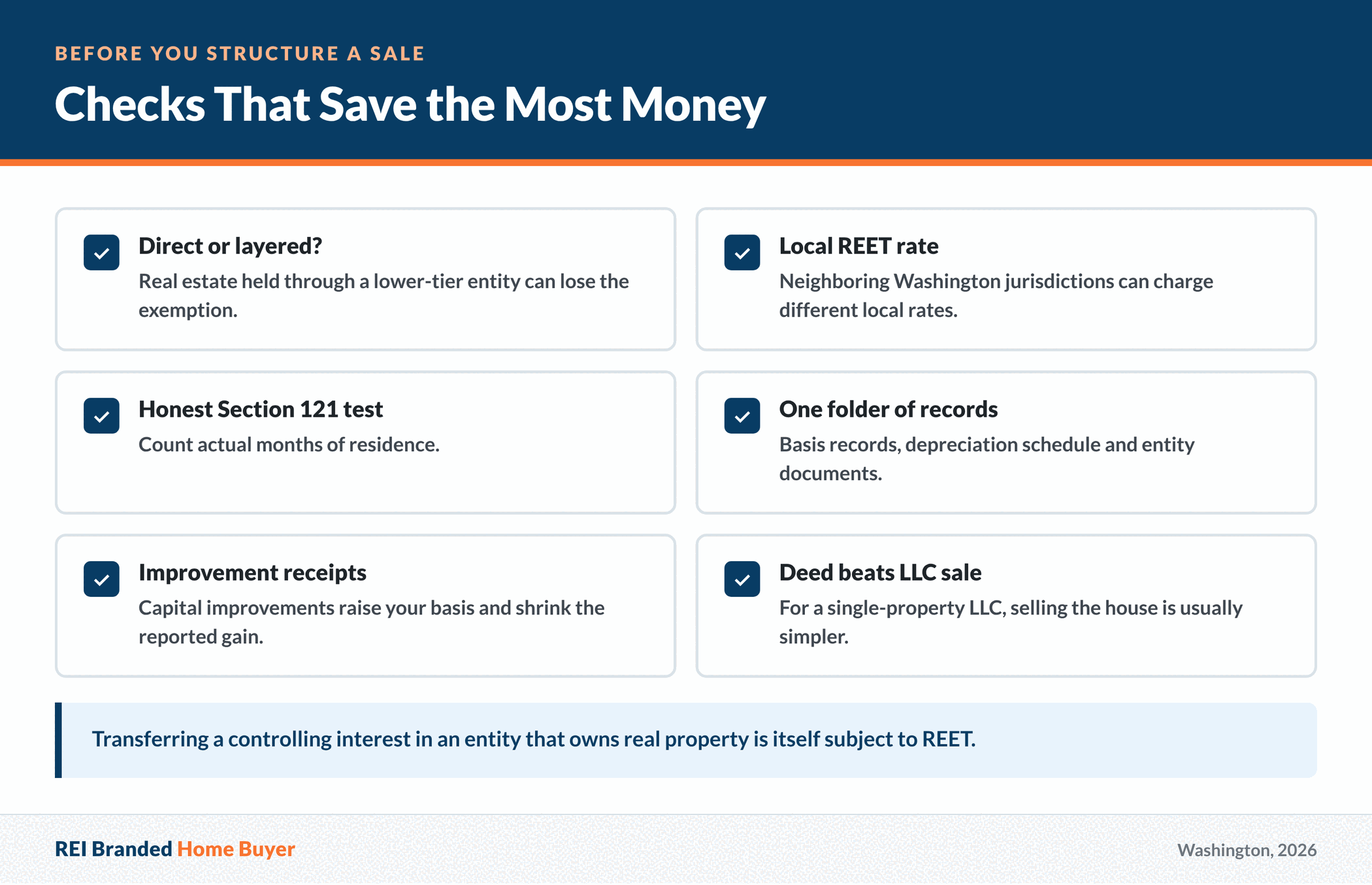
Three checks save the most money. First, confirm whether the property is held directly or through a layered structure. Next, verify which local REET rate applies in your specific city, since neighboring jurisdictions in Washington can differ. Finally, run the federal exclusion test honestly, counting actual months of residence instead of what you’d like to be true.
A landlord in Olympia reached out mid-divorce, splitting assets with a spouse who’d already moved out of state. We bought it as-is and closed on a Thursday. The whole thing stayed out of the lawyers’ way.
Situations like that are why selling direct exists. When speed and certainty matter more than squeezing out the last three percent, REI Branded Home Buyer handles the transaction without the listing circus.
Frequently Asked Questions
Does Washington State Have a Capital Gains Tax at All?
Yes, Washington has one, but it targets long-term gains on financial assets like stocks and certain business interests. Real property is carved out by statute, so your house, your rental, and your raw land all sit outside it. The Department of Revenue confirms this in its published exemption list.
How Much Capital Gains Would I Owe on a $100,000 Profit?
On a Washington real estate sale, the state capital gains tax portion is zero because of the real estate exemption. Federally, it depends on whether the home was your primary residence and how long you lived there. Meet the ownership and use tests described earlier, and that entire profit could be excluded. If it’s an investment property, expect federal long-term rates plus depreciation recapture.
Do I Have to Buy Another House to Avoid Capital Gains Tax?
Not for a primary residence. The federal exclusion discussed above carries no reinvestment requirement, so you can take the money and rent, downsize, or move to Arizona. Investment property is different. Deferring federal gain there generally means a 1031 exchange, with its own strict identification and closing windows.
What’s the Smartest Way to Reduce Tax on a Washington Real Estate Sale?
Start by making sure you qualify for the federal primary residence exclusion, since that’s the biggest lever most Washington homeowners have. Investors should look at exchanges, installment structures, and careful parcel sequencing so they don’t stack into higher excise tiers. Keep every receipt for capital improvements. Those additions raise your tax base and shrink the gain you report.
Is the Excise Tax Negotiable Between Buyer and Seller?
The statute puts the obligation on the seller, though the parties sometimes negotiate who writes the check as part of the overall terms. The county won’t record the deed until it’s paid, so escrow collects it no matter what you’ve arranged privately. Build the number into your net sheet early so it doesn’t surprise you at signing.
If you’re weighing a sale and want to talk through the numbers without a pitch, reach out. I’ve walked a lot of Washington homeowners through this exact decision, and sometimes the right answer is listing with an agent instead of selling to someone like me. Either way, you’ll leave the conversation knowing where you stand. No pressure, no obligation.
What This Means for Spokane Sellers
Spokane County’s median home price sat at $479,500 in September 2026, below the $525,000 top of the first state excise tax bracket. So a typical Spokane sale pays the lowest state REET rate and no state capital gains tax at all. Selling an inherited house? Our guide on whether an executor can sell before probate closes covers the estate side. Talk with local cash home buyers in Spokane, or see where else we buy houses in Washington, including cash home buyers in Coeur d’Alene and we buy houses in Davenport.
Know Your Net Before You Sell
Send us the address and we’ll show you a net sheet with the excise tax and closing costs already counted. See how our process works, contact REI Branded Home Buyer, or fill out the short form below.
Need to Sell Your House?
Get a Fast, Fair Cash Offer. No Repairs, No Fees, No Stress!
Helpful Spokane, WA Blog Posts
- How to Sell a Fire Damaged House Fast in Spokane for Cash
- Can You Sell Your House in Foreclosure in Spokane Before the Bank Takes It
- Can an Executor Sell a House Before Probate Closes in Spokane Washington
- Can You Sell a House with Code Violations in Spokane Without Making Repairs
- Can You Sell a Spokane Rental Property with Tenants Still Living There
- Does Washington’s Capital Gains Tax Apply to Your Home Sale
- Selling an Inherited House with Siblings in Washington
- Do You Need a Permit to Sell a House in Washington State?
