

Thirty-four days. The median time a Washington home spent on the market before selling in October 2026, according to Redfin. Redfin also pegged the statewide median sale price at $587,538, down 2.1% from a year earlier. Those numbers describe homes with working furnaces and intact roofs. If your house needs repairs, the math changes, and nobody hands you a different chart. I’ve spent years buying properties across Washington that fell outside the tidy averages, and the sellers who do best are the ones who understand their own house first.
What Repairs Does Your Washington House Need?
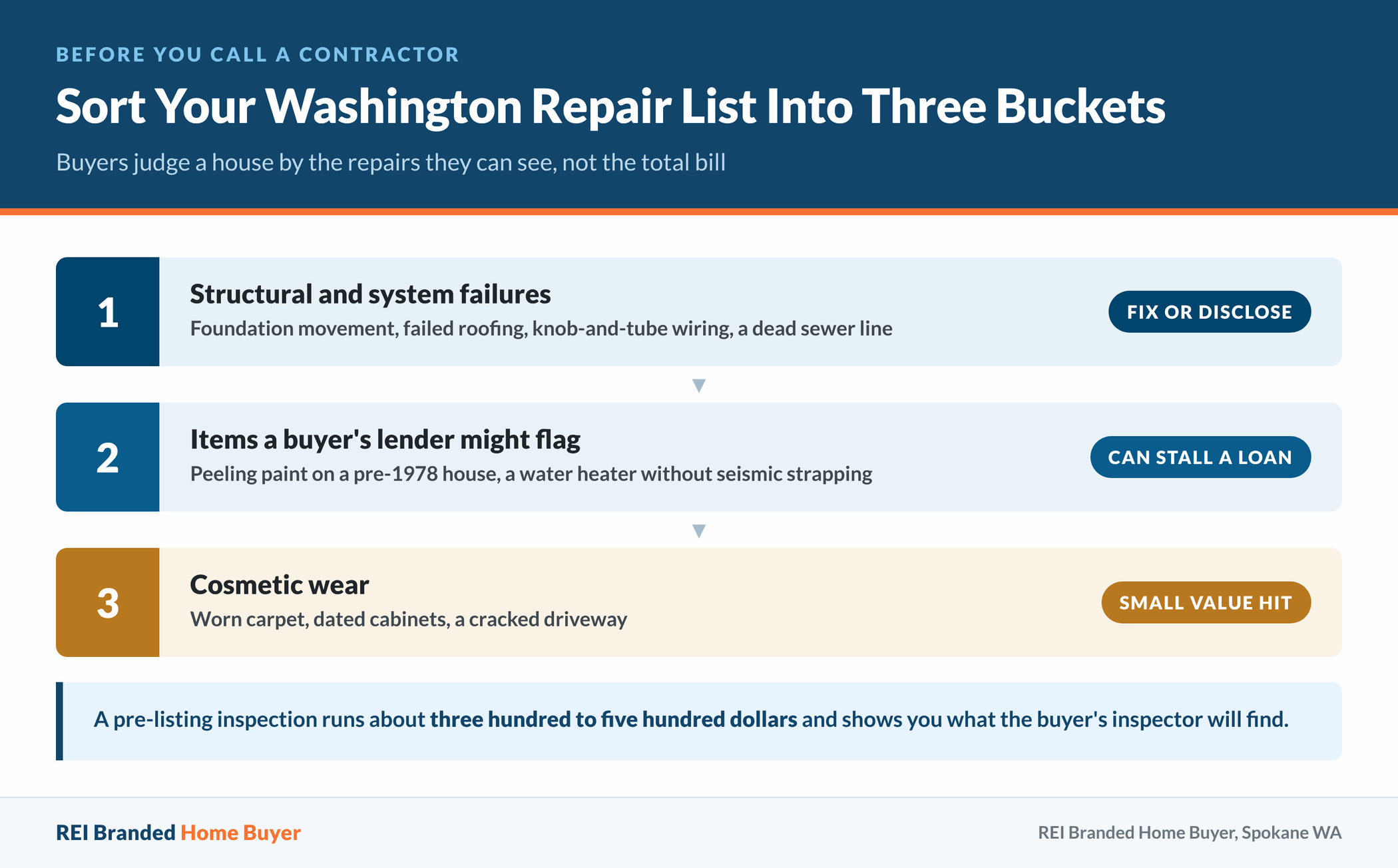
A seller once told me she was ready to replace her entire roof before listing, convinced buyers would tally every repair line by line. I used to think buyers judged a house by the total repair bill, but I was wrong: they judge it by which repairs they can see from the driveway.
Weather shapes what breaks in a Washington house. West of the Cascades, constant moisture produces dry rot in sill plates, moss-choked gutters, and crawl spaces that smell like a riverbank. Over in Spokane and the Tri-Cities, the freeze-thaw cycle cracks foundations and splits irrigation lines. A house that needs repairs in Walla Walla rarely presents the same problem list as one in Everett.
Sort your issues into three buckets before you call anyone. Structural and system failures come first: foundation movement, failed roofing, knob-and-tube wiring, a dead sewer line. Second tier covers things a buyer’s lender might flag, like peeling paint on a pre-1978 house or a water heater without seismic strapping. Everything else, worn carpet, dated cabinets, a cracked driveway, belongs in a cosmetic pile that only dings value a little.
Early last year I worked with a longtime landlord out in Marysville who’d inherited his aunt’s rental along with thirty years of her belongings. The garage held four decades of canning jars and a disassembled boat motor, and his two siblings in other states wanted nothing except a clean exit. We walked it on a Saturday, and I remember being surprised that the actual repair list turned out shorter than the cleanout list.
Get a pre-listing inspection if you can afford one. Three hundred to five hundred dollars buys you the same report the buyer’s inspector will write, except you get it before you’re under contract and losing leverage. A house that needs repairs in Washington sells on information, and the seller who knows more than the buyer keeps control of the conversation.
Is Selling a House That Needs Repairs Worth It in Washington?
Can you avoid paying taxes on a sale if the house needs work? Washington charges the seller a real estate excise tax on the gross sale price, not on profit, so the state portion is graduated rather than flat. The brackets run 1.10% on the portion at or below $525,000 and 1.28% from there to $1,525,000. Above that, the rate climbs to 2.75% up to $3,025,000 and 3.00% beyond, with details published by the Washington State Department of Revenue. Most cities and counties add a local REET of 0.25% to 0.50% on top. That bill arrives whether your house is pristine or held together with tarps.
You always pay money to sell, no matter what. It’s whether the repair spend returns more than it consumes.
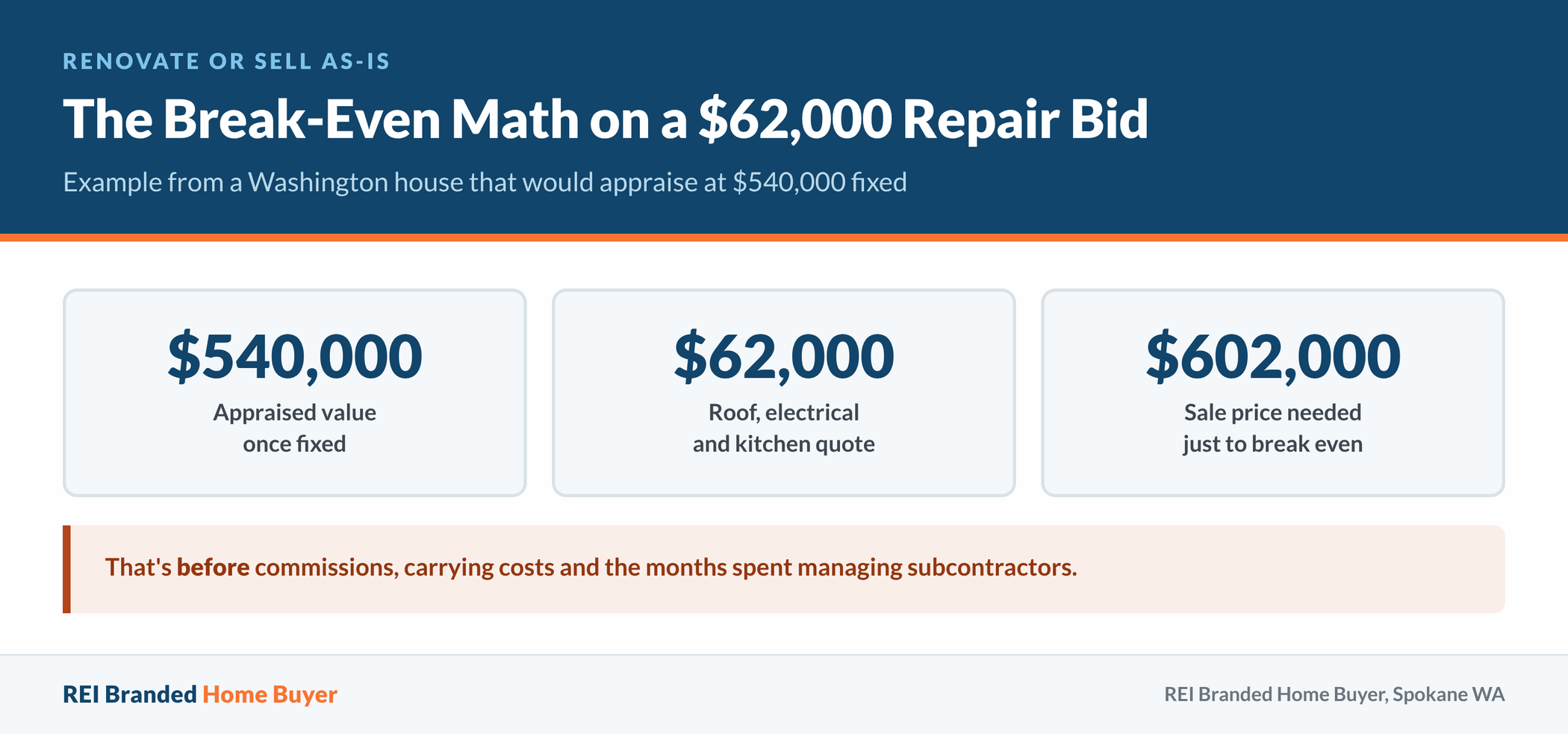
Do the math first. Say your house would appraise at $540,000 fixed and a contractor quotes $62,000 for roof, electrical, and kitchen work. You’d need the finished house to clear roughly $602,000 just to break even, before commissions and carrying costs and the four months you spent managing subcontractors. In a market where prices drifted down year over year, betting on appreciation to cover the gap is speculation, not strategy.
Renovating to sell only really makes sense in a narrow band of situations. One or two defects are scaring off otherwise-interested buyers. You have cash that isn’t borrowed. Your schedule lets you supervise the work without taking time off. Miss any of those three and the project usually eats its own return.
Selling a house that needs repairs as-is isn’t surrender. Plenty of Washington buyers specifically want projects: owner-occupants hunting for a Craftsman bungalow in Tacoma’s North End, small investors working Yakima and Bremerton. Your buyer pool shrinks but doesn’t vanish. The real cost of a Washington house that needs repairs is usually the waiting, not the discount.
Can You Finance Renovations Before Selling in Washington?

Homeowners call me regularly planning to borrow against the house, fix it up, then sell high and pay off the loan at closing. That plan hits a wall almost immediately, because renovation mortgages are built for buyers, not sellers. I’ve had to explain this on calls more than once: an FHA 203(k) requires the property to be your primary residence, and you must occupy it within 60 days of closing. You cannot use one to flip your own house and leave.
Some sellers turn to a HELOC or cash-out refinance instead. Those work mechanically, but they’re slow and they put your equity at risk. Lenders in Washington want appraisals, and appraisers discount a house that needs repairs. Your borrowing capacity is lowest exactly when you need it most.
Fannie Mae’s HomeStyle program is broader. It allows primary residences, second homes, and investment properties, typically wants a 620 credit score, and permits structural work plus features that FHA excludes. That’s a tool for the person buying your house, not for you. Point it out to interested buyers; a buyer who can finance repairs into their mortgage can pay you more than one who can’t.
Contractor financing deserves a warning. Promotional rates balloon after the teaser period, and you’re often signing a lien against the property you’re trying to sell.
I keep seeing the same mistake in Washington: a seller borrows $40,000, gets halfway through a kitchen, runs out of money, and now owns a house that needs repairs plus a monthly payment. Half-finished work appraises worse than untouched work. Buyers trust an original 1972 kitchen more than somebody’s abandoned weekend project.
If you genuinely can’t finance the work, that’s useful information rather than a dead end. It narrows your path to two good options: price for condition on the open market, or sell direct to a buyer who pays cash and handles the repairs themselves. REI Branded Home Buyer LLC is one of those direct buyers, and conversations like this one are worth having before you sign anything with a lender.
How Do You Price a House That Needs Repairs in Washington?
“What’s my house worth if I do nothing?”
Start with after-repair value, then subtract. Pull three recent sales of comparable homes in your neighborhood that sold in renovated condition. Subtract the full contractor cost of your repair list, not your optimistic estimate. Then subtract again for the buyer’s risk and profit, because nobody takes on a project for zero margin.
The county you’re selling in sharpens the number. In October 2026, King County posted a median sold price of $838,990 with 28 median days on market. Pierce County came in at $566,250 and 26 days, per Northwest MLS data compiled by Beyond Real Estate. A house that needs repairs in Bellevue discounts differently than the same house in Centralia, because the renovated comp sits so much higher.
Overpricing a distressed property is the most expensive mistake Washington sellers make. The listing sits. Buyers assume something worse is hidden. Then you reduce, and the price-drop history itself becomes a negotiating weapon against you.
Price it where the project pencils for a buyer and you’ll often get multiple offers, which is the only reliable way to push a condition-priced house upward.
One judgment call I’ll defend: skip the “needs TLC” language. That phrase signals cosmetic work to a buyer who then discovers a failing foundation and walks, so you’re better off describing the house that needs repairs plainly. List what’s broken and attract people who came for exactly that.
What Selling Points Can Offset a House That Needs Repairs?
One 1950s rambler in Spokane Valley had a condemned roof and original wiring. It also sat on a quarter-acre corner lot with mature fruit trees, and it sold in eleven days to a couple who wanted the land.
Buyers in most Washington markets weigh location more than condition. Walkability to a light rail station, a Bellingham address inside the Happy Valley school boundary, waterfront access on Hood Canal: those are things no renovation can manufacture. Lead with them.
Lot size and zoning deserve real attention right now. Washington’s middle housing legislation has pushed many single-family lots toward allowing additional units, and developers reading your listing will do that math quickly. A tired house on a lot that permits a duplex is worth more than a tidy house on a lot that doesn’t.
What else works? Transferable warranties on anything recently replaced. Even a newer furnace or a five-year-old water heater reassures buyers that not every system is at end-of-life. Documented permits for past work matter enormously in Washington, where unpermitted basements and decks are common and buyers price that uncertainty into their offers.
Clean beats renovated. A house that needs repairs but has been swept, de-cluttered, and lit well photographs far better than one with the same defects and junk in every room. Haul it out, trim the shrubs, and let the problems look like known problems rather than mysteries.
In Washington, honest disclosure is itself a selling point. State law requires most sellers to deliver Form 17, the Real Property Transfer Disclosure Statement, under RCW 64.06, and used well, it converts a suspicious buyer into an informed one.
Where Can You Sell a House That Needs Repairs in Washington?

One woman in Port Orchard called me about her late father’s house after two agents told her to spend $30,000 before listing. She had $4,000 and a mortgage payment due in nine days.
Your options sort into three channels. A traditional MLS listing reaches the largest buyer pool and typically produces the highest gross price. Financed buyers, though, bring appraisals and inspections. A house that needs repairs can fail lender condition requirements outright. FHA and VA appraisers in Washington flag peeling paint, missing handrails, and active roof leaks.
Listing as-is on the MLS with full disclosure works, even though few agents admit it. You attract investors and cash-ready owner-occupants, and competition among them sets the price rather than a single lowball negotiation.
Selling to a direct cash buyer is the second channel. You trade some gross price for certainty, speed, and zero repair spend. It’s worth finding local operators in Washington who actually close, rather than wholesalers who tie up your contract and shop it around. REI Branded Home Buyer LLC buys in this lane and will explain the number rather than just hand it to you.
Auction is the third path, and I’d use it sparingly. Washington auction results for distressed residential property swing wildly, and the fees come off your side.
Which channel fits depends on one question: what’s your actual deadline? Someone with eight months and a stable mortgage should list. Anyone staring down a payment they can’t make needs a closing date they can rely on.
Ask any buyer for proof of funds. Then ask for a reference from a Washington seller they closed with. Anyone who hesitates on either request has told you something.
How Do You Negotiate the Sale of a House That Needs Repairs?
Sellers lose the most money in the window between inspection and closing, not at the listing price.
The pattern repeats constantly. You accept a strong offer, the inspector finds what you already knew, and the buyer’s agent sends a repair demand that’s really a price-reduction demand. Now you’re negotiating from a weaker position because your house has been off the market for three weeks.
Front-load everything. Share your pre-listing inspection with offers. Price the known defects into the asking number and say so in the listing remarks. When a buyer’s inspection surfaces nothing new, their renegotiation leverage disappears.
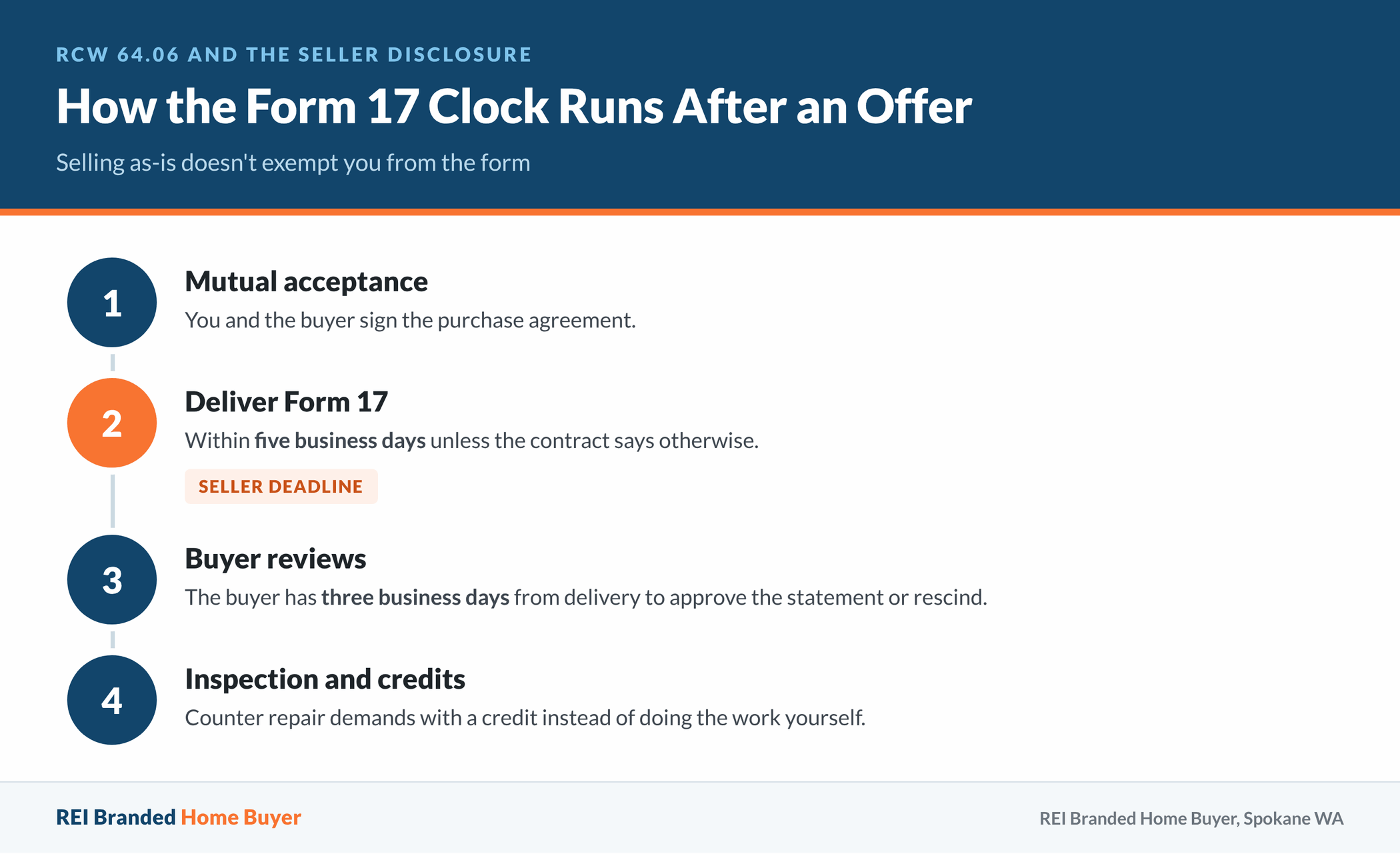
Washington’s disclosure timeline shapes this. Sellers must deliver the completed Form 17 within five business days of mutual acceptance unless the contract says otherwise, and the buyer then has three business days from delivery to rescind. Selling as-is does not exempt you from the form or from disclosing known material defects. Details on the statute are available through the Washington State Legislature’s RCW database.
Counter with a credit instead of doing the work. Repair credits close faster, you avoid managing contractors you’ll never see again, and the buyer gets to hire someone they trust.
Hold firm on earnest money terms. A buyer who won’t put meaningful money at risk on a house that needs repairs is keeping a free option open while your listing goes stale.
How Do You Sell a House That Needs Repairs in Washington?
…which brings the whole thing down to sequence. Order your steps: inspect, sort the repair list, price against real comps, choose your channel, then disclose completely and negotiate from documentation rather than emotion.
Set your timeline backward from a real date. Statewide, sellers in October 2026 received 98.4% of list price on average in a market the same data called balanced. Add thirty days for closing on a financed sale, and a September listing becomes a November closing, so plan around that stretch rather than the listing date alone. Cash sales on a house that needs repairs in Washington can close in two to three weeks, since there’s no appraisal and no lender condition review.
Gather your documents now, because every channel wants the same stack: the deed, any permit records, past inspection reports, warranty paperwork, and your mortgage payoff figure. Washington buyers and escrow companies move faster when this is ready on day one.
One seller in Olympia reached out midway through a divorce, splitting assets with an ex who’d already moved to Oregon. The house had a soft subfloor in the laundry room and a detached shop full of motorcycle parts neither of them wanted. What she asked for wasn’t top dollar; she asked for a closing date her attorney could put in the settlement.
Frequently Asked Questions About Selling a House That Needs Repairs in Washington
How Long After You Sell Your House Are You Responsible for Repairs?
In Washington, you’re not responsible for fixing anything after closing simply because it breaks. Your exposure comes from the disclosure statement: if you knowingly concealed a material defect, a buyer can pursue a claim well after the sale, and the deadline depends on the legal theory they use. A real estate attorney in your county can give you the applicable limitations period for your situation.
Do I Have to Tell Buyers About Problems If I Sell a House That Needs Repairs As-is?
Yes. Marketing a property as-is in Washington signals that you won’t be making repairs, but it doesn’t erase the state’s disclosure duty or cancel the buyer’s right to inspect. You answer from your actual knowledge, and “don’t know” is a legitimate answer when it’s true. Guessing or glossing over a known issue is what creates liability.
Will a Lender Let a Buyer Finance a House That Needs Repairs in Washington?
Sometimes, depending on the severity. Conventional lenders tolerate cosmetic issues, but government-backed appraisers in Washington flag health and safety conditions, and a failing roof or exposed wiring can kill the loan. Buyers using renovation mortgages can finance the work, though those loans take longer to close and carry occupancy rules.
Should I Fix Anything at All Before Selling a House That Needs Repairs?
A few things earn their cost almost every time: clearing junk, cutting back overgrowth, fixing anything actively leaking, and making sure the house is safe to walk through. Those are cleanup items, not renovations. Large projects rarely return their cost on a Washington property already priced for condition, and half-finished work is worse than none.
How Fast Can I Close on a House That Needs Repairs in Washington?
With a cash buyer and a clean title, two to three weeks is realistic, and escrow timelines vary a little by county. Financed sales take longer because of appraisal and underwriting. If probate, a lien, or unrecorded heirs are involved, title work drives the schedule more than anything else does.
When you’ve got a Washington house that needs repairs and you’re not sure which way to go, I’m happy to walk through the numbers with you. Sometimes the answer turns out to be listing with an agent instead of selling to us. Reach out through reibrandedhomebuyer.com whenever you’re ready. No pressure, no obligation, and no one will chase you afterward.
Spokane Sellers With a House That Needs Repairs
Spokane County’s median price sat near $435,000 in September 2026, according to a Coeur d’Alene Press market report. That number describes houses in good shape. When yours needs work, the price depends on how buyers read your repair list, so it helps to talk with a local buyer who works across Washington before you spend money on contractors.
Talk Through Your Washington Repair List With Us
If you’d like a second opinion on a house that needs repairs, contact REI Branded Home Buyer and tell us what’s going on with the house. You can also fill out the form below. There’s no obligation, and if listing makes more sense for you, we’ll say so.
Need to Sell Your House?
Get a Fast, Fair Cash Offer. No Repairs, No Fees, No Stress!
Helpful Spokane, WA Blog Posts
- How to Sell a Fire Damaged House Fast in Spokane for Cash
- Can You Sell Your House in Foreclosure in Spokane Before the Bank Takes It
- Can an Executor Sell a House Before Probate Closes in Spokane Washington
- Can You Sell a House with Code Violations in Spokane Without Making Repairs
- Can You Sell a Spokane Rental Property with Tenants Still Living There
- Does Washington’s Capital Gains Tax Apply to Your Home Sale
- Selling an Inherited House with Siblings in Washington
- Do You Need a Permit to Sell a House in Washington State?