
A seller in Everett called me last spring convinced her sale would net her around $480,000. Her mortgage payoff was $210,000 and her agent had the house priced at $540,000. She’d done the subtraction in her head, and the math felt clean. By the time escrow cut her check, she was about $34,000 lighter than that number, and none of it was a surprise to anyone except her. This gap is the whole reason this article exists, and I’ve sat at enough closing tables to see the same shock cross someone’s face. The cost to sell in Washington is not one line item. It’s a dozen of them stacked quietly on top of each other, and most sellers only meet them at the signing table.
How Much Does It Cost to Sell a House in Washington?
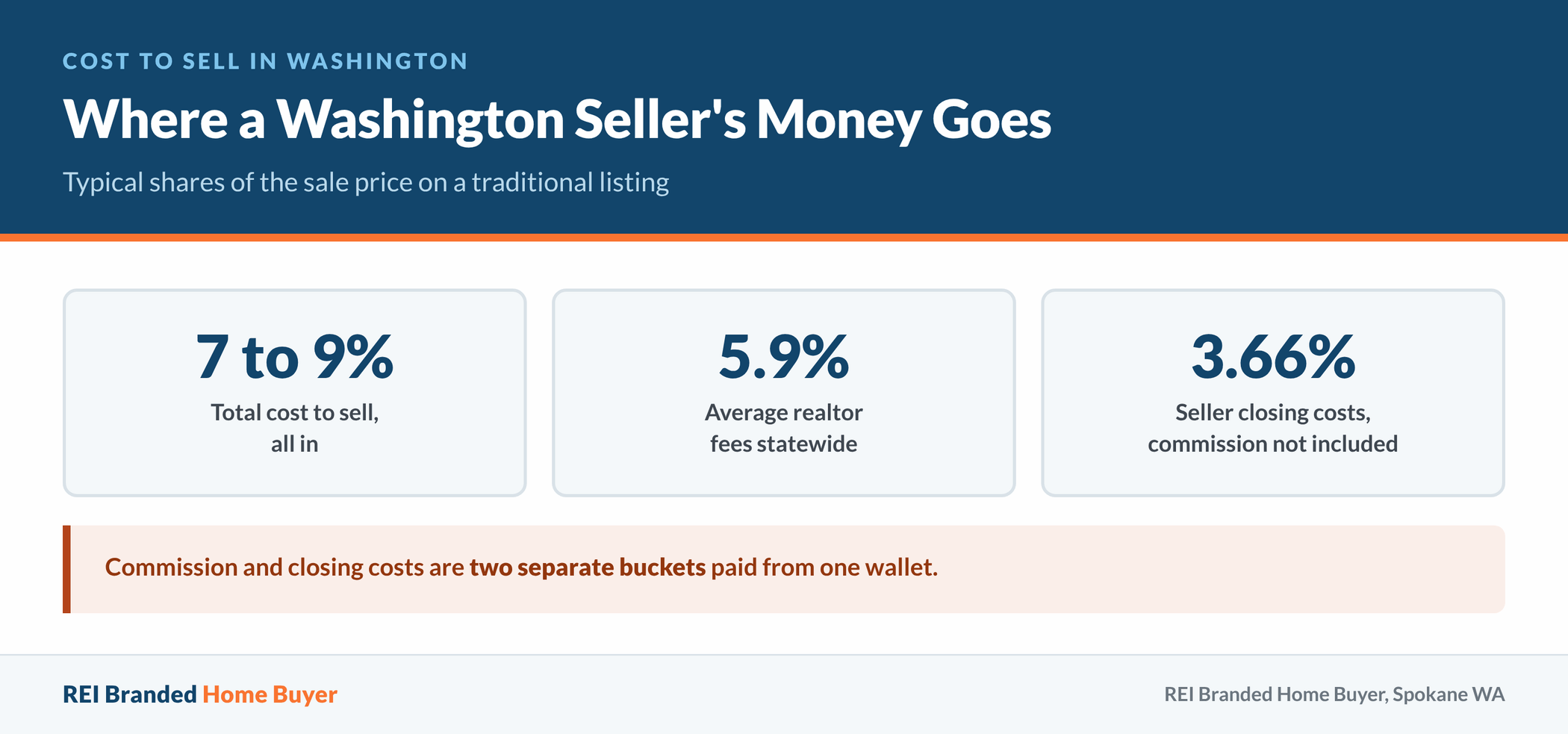
So what’s the real number? Most Washington sellers who list traditionally give up somewhere between 7 and 9 percent of the sale price. Local brokers quote that range once you fold in agent commissions, excise tax, title, escrow, and prep work. On a median-priced house, that’s real money leaving the table.
Let’s anchor it to something current. Redfin’s October 2026 data puts the Washington median sale price at $587,538, down 2.1 percent from a year earlier. Run 8 percent against that and you’re looking at roughly $47,000 in total cost to sell, before you’ve paid off a dime of your mortgage.
That number shocks people. It shouldn’t.
In Washington, sellers carry an expense most states don’t, and I’ll get into the excise tax shortly. Commissions still do the heaviest lifting, though. Average realtor fees across Washington run about 5.9 percent. Even post-settlement, buyer agent compensation hasn’t vanished from most Puget Sound sales; it’s just negotiated differently now.
Not long ago I worked with a young couple in Spanaway who were three months behind on their mortgage. Their auction date was already circled on the calendar. They had a half-rebuilt motorcycle in the garage and about five weeks of runway. Listing would’ve cost them the house, so we closed on a Tuesday and they walked away with equity instead of a foreclosure on their credit.
Sellers often expect the cost to sell to track the statewide average, but geography moves it more than that. A Bellevue sale and a Yakima sale carry wildly different dollar figures even at the same percentage. King County’s median sold price sat at $838,990 in October 2026, while Pierce County came in at $566,250. Same rules, very different checks.
What Drives Up the Cost to Sell in Washington?
“My agent said closing costs are small.” Your agent isn’t wrong about closing costs in the narrow sense. Closing costs alone average about 3.66 percent for sellers here, which sounds tolerable until you learn that figure typically doesn’t even include commission. Two separate buckets, one wallet.
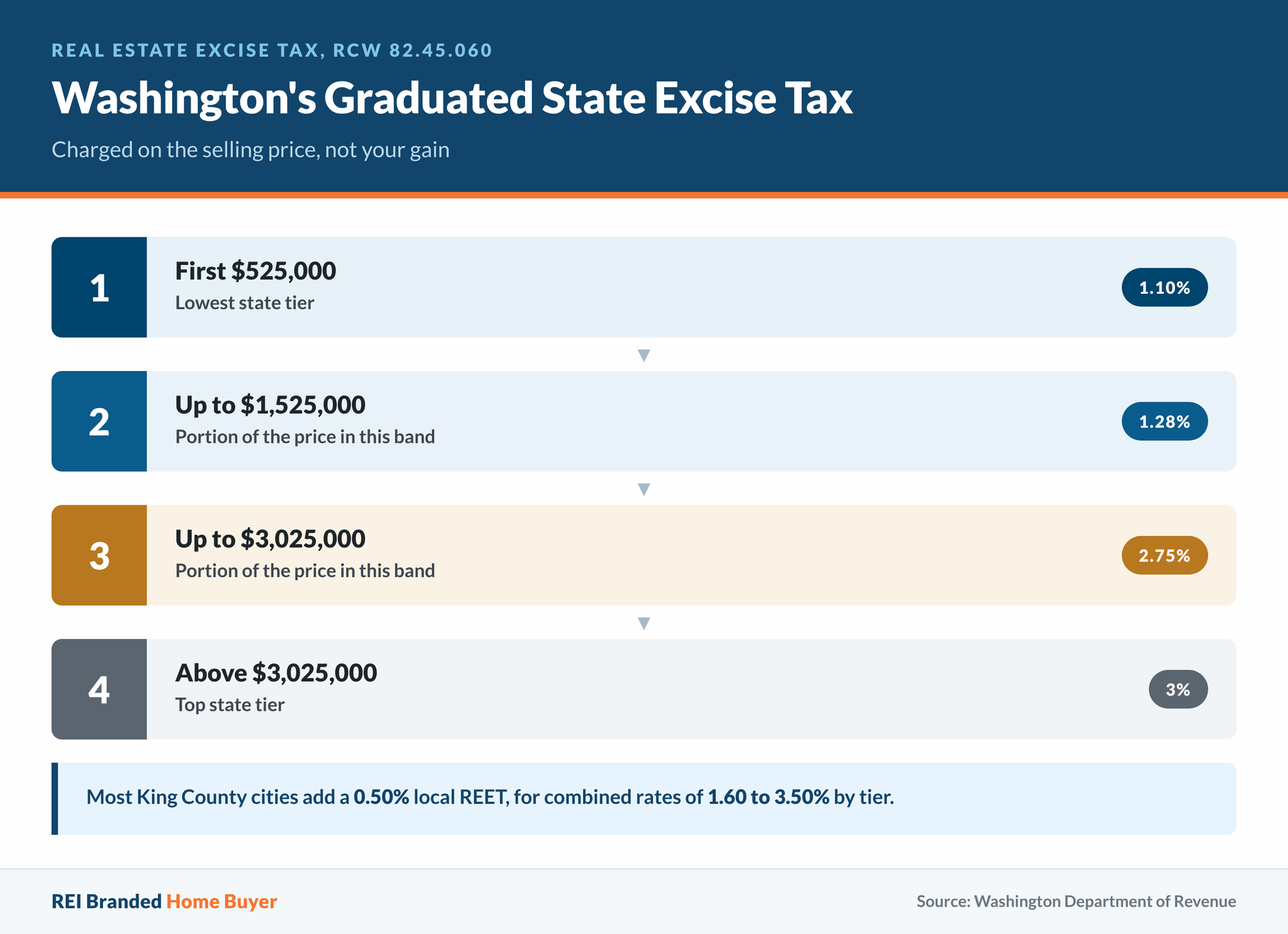
Washington’s real estate excise tax is the line that pushes our cost to sell above most of the country. The state rates are graduated under RCW 82.45.060: 1.1 percent on the lowest tier, 1.28 percent on the next, 2.75 percent above that, and 3 percent at the top. It’s due at sale, before the deed can be recorded. According to the Department of Revenue’s FAQ page, the lowest rate covers the first $525,000 of the price. The next runs to $1,525,000, and the third reaches $3,025,000 before the top rate kicks in.
Cities and counties pile on their own slice. Most King County cities charge a 0.50 percent local REET, including Seattle, Bellevue, Kirkland, Kent, Renton, and Tukwila. This means combined effective rates land between 1.60 and 3.50 percent depending on the price tier.
One detail that stings: the tax is charged on your selling price, not your gain, so a seller walking away with nothing still owes it.
What a house needs always factors into the final price. Inspection negotiation in a balanced market is where sellers bleed. Statewide, sellers were netting 98.4 percent of list price in early October 2026, and that gap is mostly repair credits. I’ve seen a roof flagged by an inspector in Puyallup cost more at the table than the roof would have cost to replace.
Have you priced out what a buyer’s lender will demand before funding? Deferred maintenance that you’ve lived with happily for a decade can stop a mortgage cold.
Itemized Closing Cost Estimate for Washington Sellers
Sellers picture one commission check and a modest escrow fee. The settlement statement runs longer than that, and the smaller lines add up fast enough to matter.
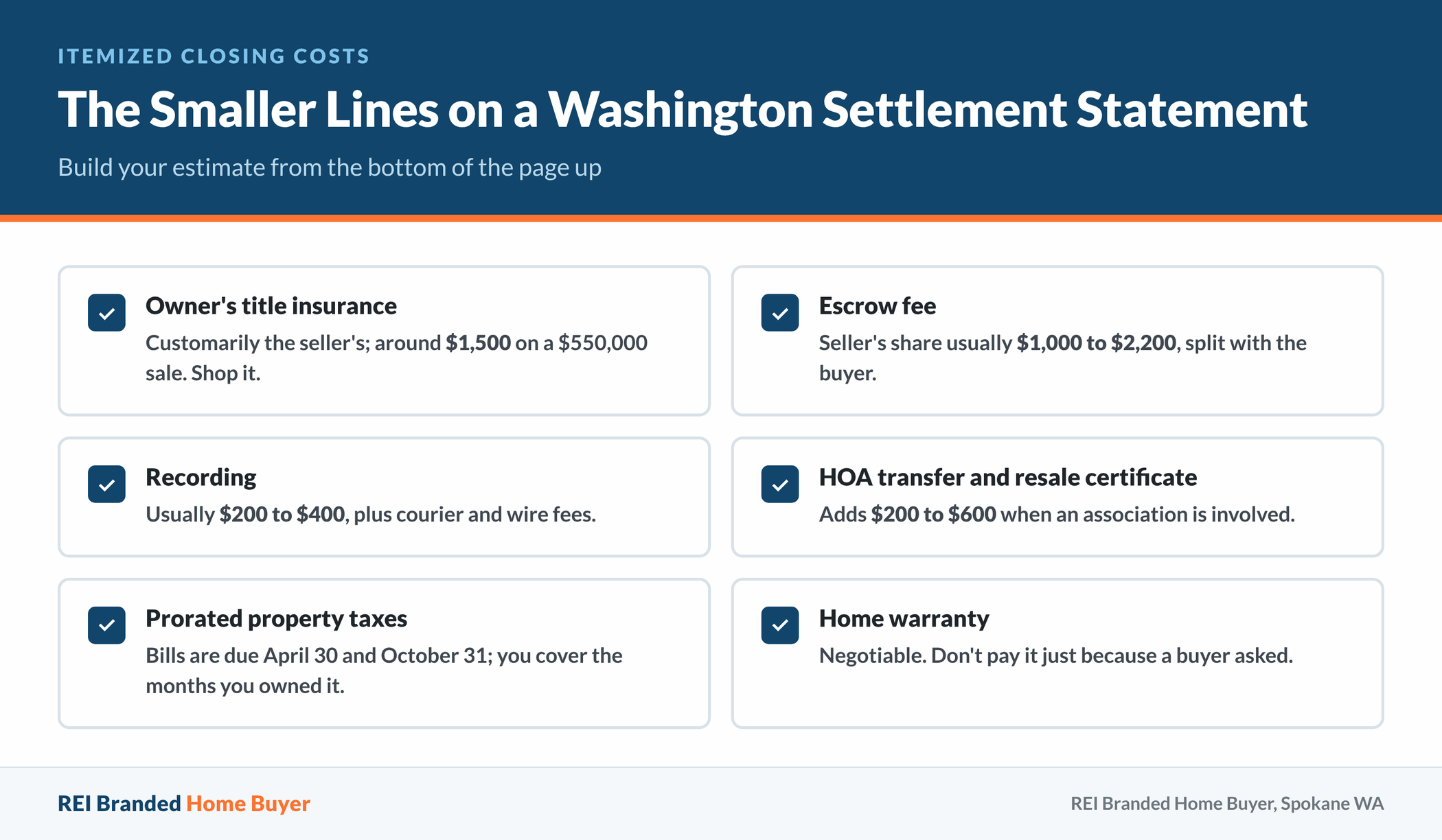
Owner’s title insurance is customarily yours in Washington, not the buyer’s, which surprises people relocating from other states. On a $550,000 sale, that policy runs around $1,500. Shop it. Each title insurer files its own rates with the state insurance commissioner, so quotes from different companies genuinely differ.
Escrow handles your closing here; attorneys rarely do. The seller’s share of escrow commonly lands between $1,000 and $2,200, usually split down the middle with your buyer.
Then come the small ones. Recording fees, courier charges, wire fees. The recording charge usually runs $200 to $400, with HOA transfer and resale certificate fees adding $200 to $600 when a homeowners association is involved. Don’t pay a home warranty premium just because a buyer asked. It’s negotiable, and in a market where sellers are still getting close to asking, you have leverage.
Property taxes get prorated at closing, which trips up sellers who pay through an escrow account and never think about it. You cover the portion of the year you owned the home, the buyer picks up from closing forward, and escrow sorts it out. First-half bills are due April 30 and second-half October 31 in Washington, so a September closing means you’re settling up for months you already lived there.
One pattern I keep seeing: sellers budget carefully for commission and then get blindsided by the stack of smaller add-on items. Build your cost to sell estimate from the bottom of the page up, not the top.
The Hidden Cost of Carrying Your Home Until It Sells
A landlord in Tacoma inherited a duplex and listed it the same month his tenant moved out, figuring it would sell fast. Seven months later it was still listed, and he’d paid every mortgage payment, every utility bill, and two rounds of landscaping on a vacant building.
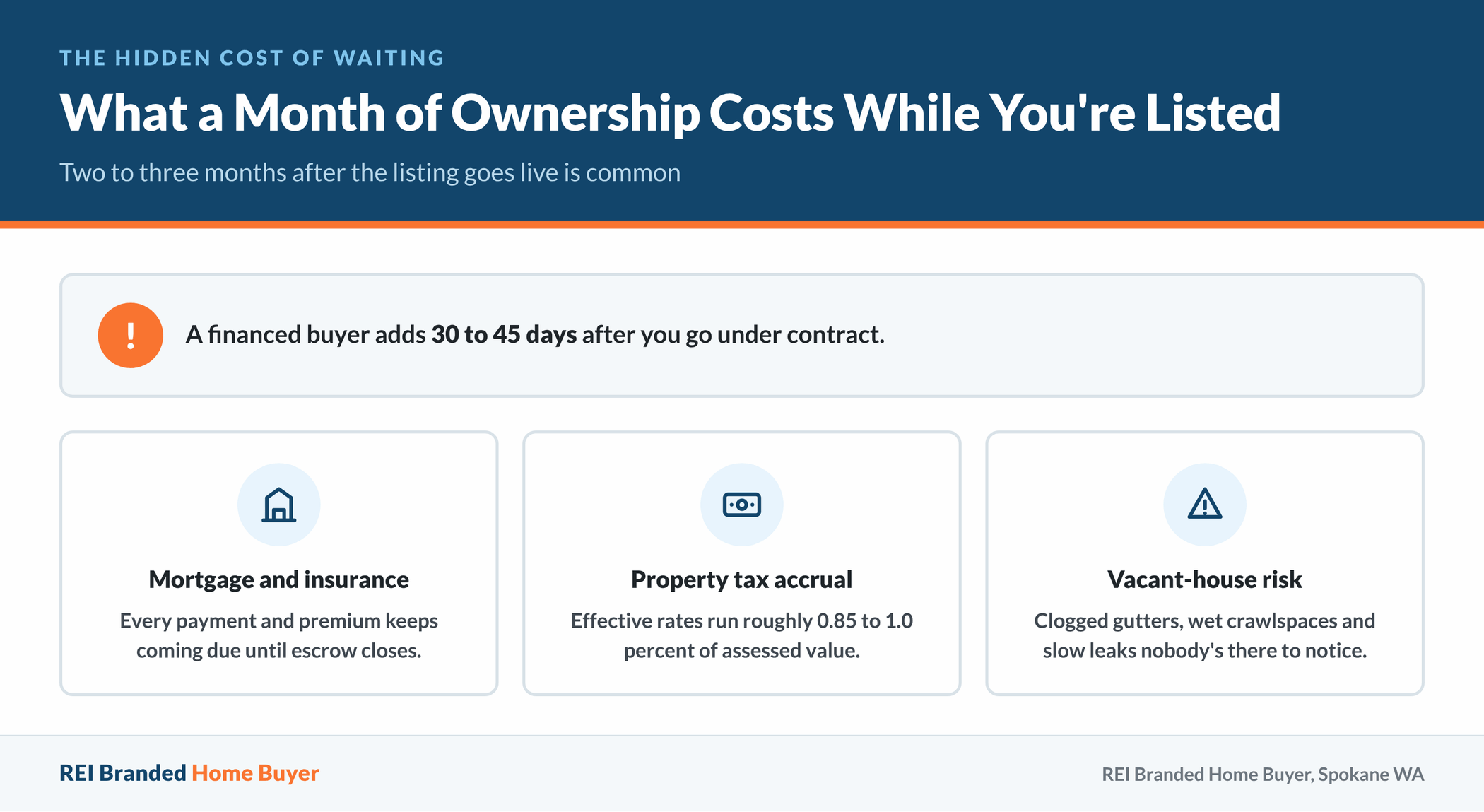
Carrying costs are the expense nobody puts on a net sheet, and they’re often larger than the title and escrow fees combined. Median days on market in Washington hit 34 days in October 2026, up seven days year over year. That’s just the time to get under contract. Add 30 to 45 more for a financed buyer to close, and you’re frequently at two to three months of ownership after the listing goes live.
What does a month of ownership cost? Your mortgage payment, insurance, utilities, lawn care, and property tax accrual. Washington’s average effective property tax rate runs roughly 0.85 to 1.0 percent of assessed value. On a Snohomish County house, where the median sold price was $697,000 in October 2026, that’s a meaningful monthly carry all by itself.
Western Washington winters punish vacant houses. Gutters clog, crawlspaces take on water, moss colonizes a north-facing roof, so small problems turn into real damage fast. I’ve walked into empty Kitsap County homes in February where the only real damage came from nobody being there to notice a slow leak.
Rainy-season showings slow down too, which stretches your timeline right when carrying costs hurt most.
Here’s the stance I’ll defend. A seller with an urgent deadline who chases an extra $15,000 over four additional months usually loses that money to carry, price reductions, and stress. The cost to sell goes up every week the house sits. That arithmetic doesn’t care how good the house is.
How Washington Home Pricing Strategy Affects Your Total Cost to Sell
Price too high, and what happens next? Overpricing is the single most expensive mistake a Washington seller can make, and it costs more than any fee on your settlement statement.
Price a house above the comps and you get the quiet treatment. No showings the first weekend, a trickle the second, so your listing goes stale while buyers assume something’s wrong with it. A correction always comes, and it usually overshoots.
You should factor in the market context when you set that number. Washington prices were down 2.4 percent year over year as of late October 2026. Homes were selling in a median of 32 days active, with sellers receiving 98.5 percent of list on average. A softening market punishes ambitious pricing harder than a rising one, because there’s no appreciation coming to rescue you.
Ballard and Spokane Valley don’t sell on the same calendar. Seattle’s median house sold for $983,750 as of September 2026, with homes going in a median of 22 days active. Redmond and Sammamish move on tech hiring cycles; Spokane runs on a different clock entirely. Your listing agent should be pulling comps from your specific zip code, not a county average.
Who pays when you price wrong? You do, twice: once in carrying costs and again in the discount buyers demand from a listing that’s been sitting.
Sellers should price at the number that produces three showings in the first four days. If you want certainty instead, a direct offer removes the pricing gamble altogether. Folks at REI Branded Home Buyer LLC underwrite to a fixed number and a fixed date. You know the cost to sell before you commit rather than discovering it later.
Price cuts also tend to arrive too late. By the time a seller agrees to drop $25,000, the listing has usually already lost the buyers who would have paid closer to the original ask.
How Do You Calculate Your Own Cost to Sell?
Get this calculation wrong and you show up to closing owing money you don’t have, or you accept an offer that leaves you short on your next down payment. Both happen in Washington every week.
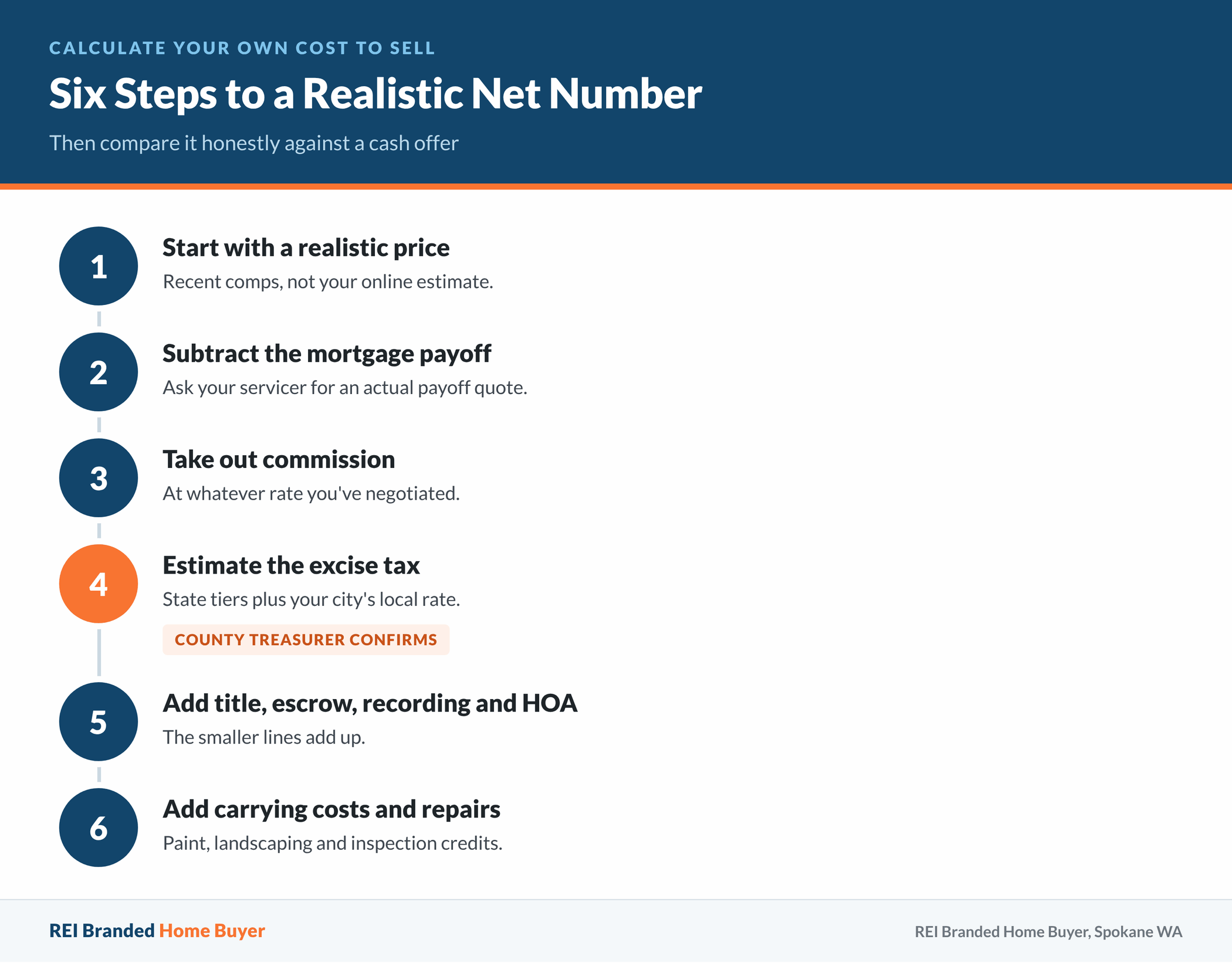
Start with your realistic sale price, not your Zillow estimate. Subtract your mortgage payoff, which includes interest accrued through the closing date plus any recording charges your lender tacks on. Call your servicer for an actual payoff quote.
Next, take out commission at whatever rate you’ve negotiated. Then the excise tax, which you can estimate using the tier structure above plus your city’s local rate. Your county treasurer’s office collects it and can confirm the exact local percentage for your parcel. Washington’s Department of Revenue publishes the current rate tables.
Add title, escrow, recording, and any HOA charges. Then add the part most net sheets skip, your carrying costs for the expected marketing and closing window. Include whatever you’ll spend on paint, landscaping, and the inspection repairs you’ll end up crediting.
Compare that figure against a cash offer honestly. A direct sale usually comes in under market, but it strips out commission, repairs, and most carrying costs. Sometimes the net lands within a few thousand dollars of a traditional listing. Other times listing wins by a wide margin. Run both; the right answer depends on your house and your timeline, not on a slogan.
A seller in Camas had a contractor estimate for her 1970s kitchen that exceeded what the finished kitchen would have added to her sale price. She’d been quoted the work on a Thursday. By Friday she’d decided to sell the house with the original avocado tile intact and a buyer who wanted to gut it anyway.
Frequently Asked Questions About Cost to Sell in Washington
Grab a pen and your last mortgage statement; these are the questions that come up at almost every kitchen table I sit at.
What Will Closing Cost Me on a $300,000 Washington Sale?
At that price your entire sale sits inside the lowest excise tax bracket, so the state portion is calculated at the bottom rate, plus whatever local percentage your city charges. Add commission, owner’s title insurance, your half of escrow, recording, and prorated property taxes. The overall cost to sell generally lands within the same percentage range described earlier in this article. Homes in that price band are more common in Spokane, Grays Harbor, and parts of eastern Washington than around Puget Sound.
How Much Should I Budget for Closing on a $400,000 Washington Home?
Same lowest excise tier applies, so your tax calculation works out proportionally similar to a smaller sale. Commission scales with price, which is why the percentage stays fairly stable even as the dollar total climbs. The fixed-dollar items like recording and escrow don’t scale, so they eat a slightly smaller share of a $400,000 Washington sale than a $250,000 one.
Does the Seller Always Pay the Excise Tax in Washington?
By statute the obligation sits with the seller, and escrow collects it at closing before the deed goes on record. Contracts can shift who writes the check in unusual transactions, but it’s rare. The Department of Revenue treats unpaid excise tax as something that follows the transaction rather than quietly disappearing. For any sale that might qualify for an exemption, your county treasurer or a real estate attorney should review the affidavit before you sign.
Can I Reduce the Cost to Sell by Listing Without an Agent?
You can cut the listing side of commission, yes, and some Washington sellers do it well. What you take on is pricing, disclosure forms, inspection negotiation, and scheduling, which is real work. Selling by owner tends to pay off when you already have a buyer lined up. It tends to backfire when the house needs marketing to find one.
Do Repairs Actually Lower My Total Cost to Sell?
Sometimes. Cheap fixes that affect first impressions, paint, carpet cleaning, a tidy yard, usually return more than they cost in a Washington market this balanced. Big-ticket renovations rarely do, especially kitchens and bathrooms where you’re spending retail and recovering wholesale. If a contractor quote makes you wince, that’s useful information about selling as-is instead.
How Fast Can I Close If I Sell Directly?
A direct buyer paying cash can typically close in one to three weeks, since there’s no appraisal, no lender underwriting, and no financing contingency to wait on. That speed is worth real dollars when you’re carrying a vacant house through a Washington winter or facing a deadline you can’t move. Escrow still handles the paperwork, and the excise tax still gets paid at closing the same way.
If you’re trying to figure out whether listing or selling direct makes more sense for your situation, we’re glad to walk through the numbers with you, including the ones that favor listing. You can reach us at REI Branded Home Buyer LLC whenever you’re ready. No pressure, no obligation, and no hard feelings if you decide to list instead.
Your Cost to Sell in Spokane
Spokane County’s median price sat near $435,000 in September 2026, according to a Coeur d’Alene Press market report. At that price the whole sale falls inside the lowest state excise tier, though commission and carrying costs still add up. If you’re weighing options, homeowners across Washington can get a no-obligation cash offer from us to set beside a listing.
Compare Your Washington Cost to Sell With a Cash Offer
Want to see both numbers side by side? Contact REI Branded Home Buyer and we’ll walk through your cost to sell with you. You can also fill out the form below. There’s no obligation, and if listing nets you more, we’ll tell you.
Need to Sell Your House?
Get a Fast, Fair Cash Offer. No Repairs, No Fees, No Stress!
Helpful Spokane, WA Blog Posts
- How to Sell a Fire Damaged House Fast in Spokane for Cash
- Can You Sell Your House in Foreclosure in Spokane Before the Bank Takes It
- Can an Executor Sell a House Before Probate Closes in Spokane Washington
- Can You Sell a House with Code Violations in Spokane Without Making Repairs
- Can You Sell a Spokane Rental Property with Tenants Still Living There
- Does Washington’s Capital Gains Tax Apply to Your Home Sale
- Selling an Inherited House with Siblings in Washington
- Do You Need a Permit to Sell a House in Washington State?